THE BUILDER’S FIELD GUIDE / EARLY PREVIEW

Make things.
Make sense
of them.

A useful second perspective while you build with AI. Find a better next step. Understand why it helps. Carry that lesson into whatever comes next.

Add to your project
Alongside your work inCodex&Claude Code
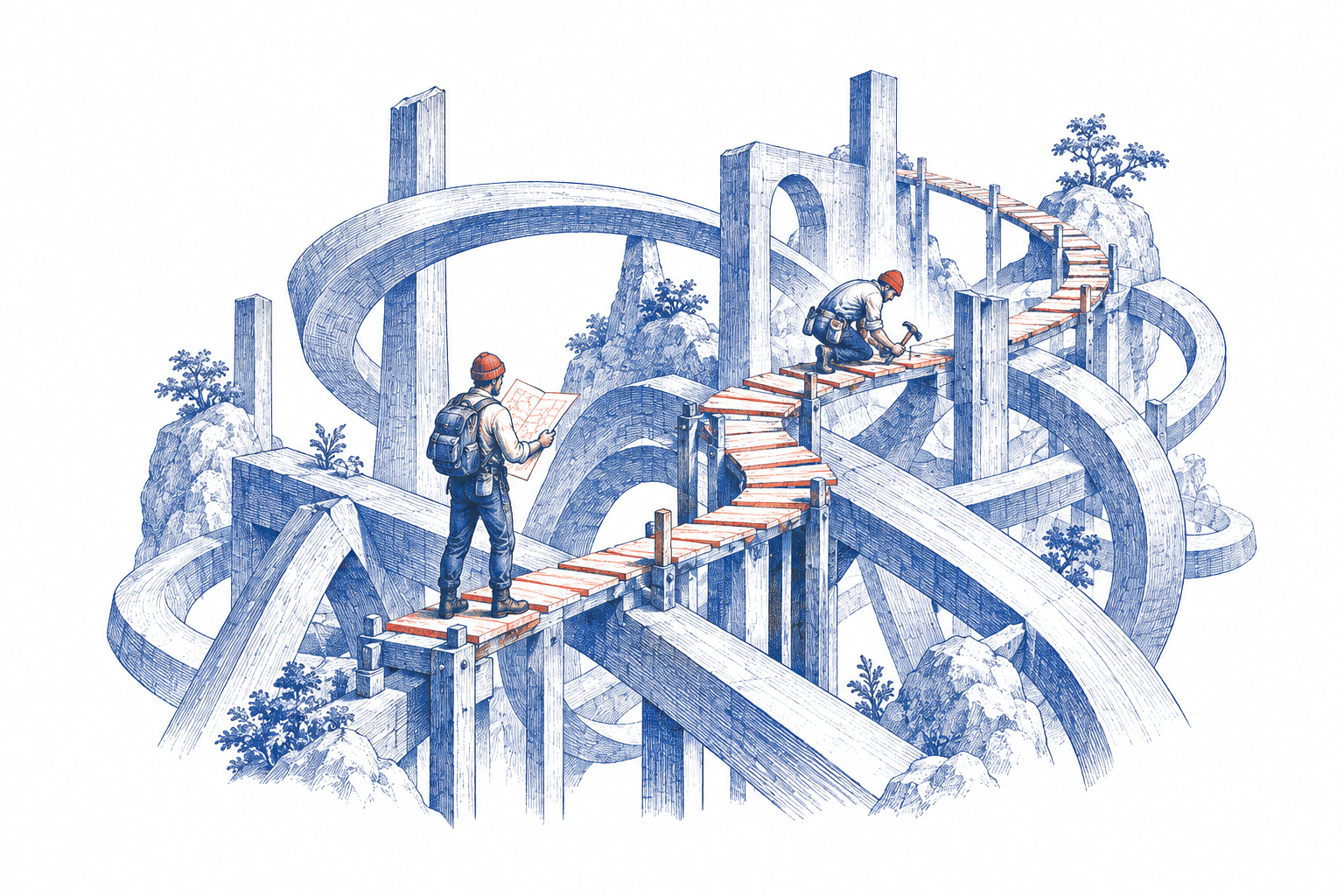
An ink illustration of builders constructing a path through a tangled structure, consulting a diagram as they go.
Fig. 01

The way forward is something you learn by making.

01 / A NOTE IN THE MARGIN

Let’s take a different approach.

Two interactive examples.
Choose a situation, then add your context.
IN YOUR WORKFLOWExample project

The same bug. Three attempts.

Your agent changed the payment handler, the retry logic, then the webhook. The duplicate-charge check still fails.

“It’s still creating two charges. Please fix it.”

WHAT THE RESULT TELLS US

The same request produces two charges. We don’t yet know which layer duplicates it.

A NOTE FROM ALONGSIDE

Test the assumption before the next edit.

Another broad fix changes several variables. First, find out whether the duplicate arrives at the API or is created after it.

WHY THIS HELPS

A feedback loop needs a clear signal. A small check tells you whether a change helped; “try again” doesn’t.

THE IDEA01—03

The work is already teaching you.
Catch the useful part.

01 / NOTICE

Start with the actual work.

A failing check or a decision with a tradeoff gives the advice somewhere to land.

02 / UNDERSTAND

Make one better move.

A specific next step, with just enough explanation to understand why you’re trying it.

03 / REMEMBER

Keep what you learn.

Save the outcome when you want to. A failed experiment can be a useful lesson, too.

THE LIBRARYSHARED EXPERIENCE

Pass on the lesson.
Keep the project.

The valuable part is what you learned: the approach, the constraints, what helped, and what didn’t.

You choose what to share. A separate, reviewed learning card can help another builder without handing over your code or conversations.

FIELD NOTE / EXAMPLE

The database was fine.
The missing piece was context.

Situation

An offline-first app. A suggested migration.

What changed

The builder explained an existing sync layer already handled offline writes.

The lesson

Ask about the constraint before changing the stack.

Illustrative, not a community report02
BEFORE YOU TRY IT

Small print. Plain English.

What can I use today?

Explore these two interactive examples and the shared library. Install the project companion for Codex, Claude Code, or both. It offers credited guidance inside your coding conversation: eight starter cards install locally and the growing catalogue is served from Alongside one card at a time, with each card crediting its public source. The companion does not yet retrieve recommendations from the shared library. The examples here are scripted, not live AI analysis.

Does it need another AI subscription?

The local prototype uses your existing coding agent and requires no second AI API key. Your agent’s usual token usage still applies. All guidance cards are free; no paid subscription is currently being sold.

Does it watch or upload my work?

The local plugin does not record sessions, collect raw conversations, or upload project files. It gives advice through your existing agent and keeps approved notes locally. Contributions to the website are separate and require explicit review and consent.

Can it promise fewer tokens or better results?

No. The point is to make the next attempt better informed, then check the result. We don’t claim savings we haven’t measured. Library outcomes remain self-reported; publication is not independent verification.

RELEASE STATUS

Local companion + shared library / Project installation available

Install Alongside ↗
ILLUSTRATIVE LEARNING CARD

The lesson. Not the project.

This is a sample of the separate card you could choose to export. No code, project identity, or conversation is included.

DEBUGGING / SELF-REPORTED EXAMPLE

One failing input beat another broad edit.

Situation
Several broad fixes left the same failure.
Approach
Reduced the case to one input and tested one hypothesis.
Outcome
The focused check passed after the targeted change.
Limitations
Illustrative example. No independent verification or measured token saving.

In the local prototype, you review every field and approve the exact card before exporting a file. Nothing is uploaded. Pattern checks cannot guarantee anonymity.

PREVIEW DETAILS

A demo you can explore privately.

This page uses scripted examples. It does not request access to your project, use an AI API, or collect an email address. Copying a sample prompt uses your browser’s clipboard only when you press Copy.

We have not added analytics or tracking cookies. The hosting provider may process routine connection and access information. Google Fonts serves the typefaces used on this site.

The local companion is a separate prototype. It uses your existing coding agent and stores approved notes in your project. Your agent’s provider policies and any operating-system file sync still apply.

The separate library page supports sign-in and explicitly approved contributions. It stores a site-specific user ID, the approved card, consent version, timestamps, and review status. Withdrawing clears card content from active records; backups and already-shared copies may persist. Project installation is available on the setup page. Paid accounts and remote companion recommendations are still in development.